
In January 2026, I ran a rank grid for "airbnb management" across Tampa Bay: 305 search points, 5 km apart, covering a 50 km radius. Emperor Rentals, the vacation rental management company I do marketing for, was not in the top 5 at a single point. Not even at the point less than a kilometer from its own office.
Today, a 5x5 grid around that same office in South Tampa shows Emperor at #1 on every point, with an average rank of 1.0.
This article is about how that happened. It's also about why the same work now pays off in three places at once: Google Maps, Google's AI Mode and assistants like ChatGPT. More and more, a homeowner looking for a local service starts in one of those three, and they all draw on the same signals.
Three doors, one customer
Until recently, local search had one front door: the Map Pack, the three businesses with a map that show up above the organic results. Today a customer looking for a roofer, an electrician or a property manager can:
- search on Google and look at the Map Pack;
- ask Google's AI Mode and get a written recommendation;
- ask ChatGPT (or Gemini, or Perplexity) "who is the best X near me?".
It looks like three different games. In practice, it's almost the same one:
- Google says its AI features, AI Overviews and AI Mode, run on the same ranking systems as regular Search, with no extra requirements to appear in them.
- Analyses of AI Mode's local answers found that the businesses in the top 3 of the Local Pack tend to be the same ones AI Mode recommends, and that proximity still shapes the answer.
- Assistants outside Google build their answers from what the web says about the business: directories, reviews, the website itself. Inconsistent data means the business gets left out, or described wrong.
The practical conclusion is that there isn't a separate "AI local SEO". There's local SEO done properly, which now shows up in more places.
The starting point: January 2026
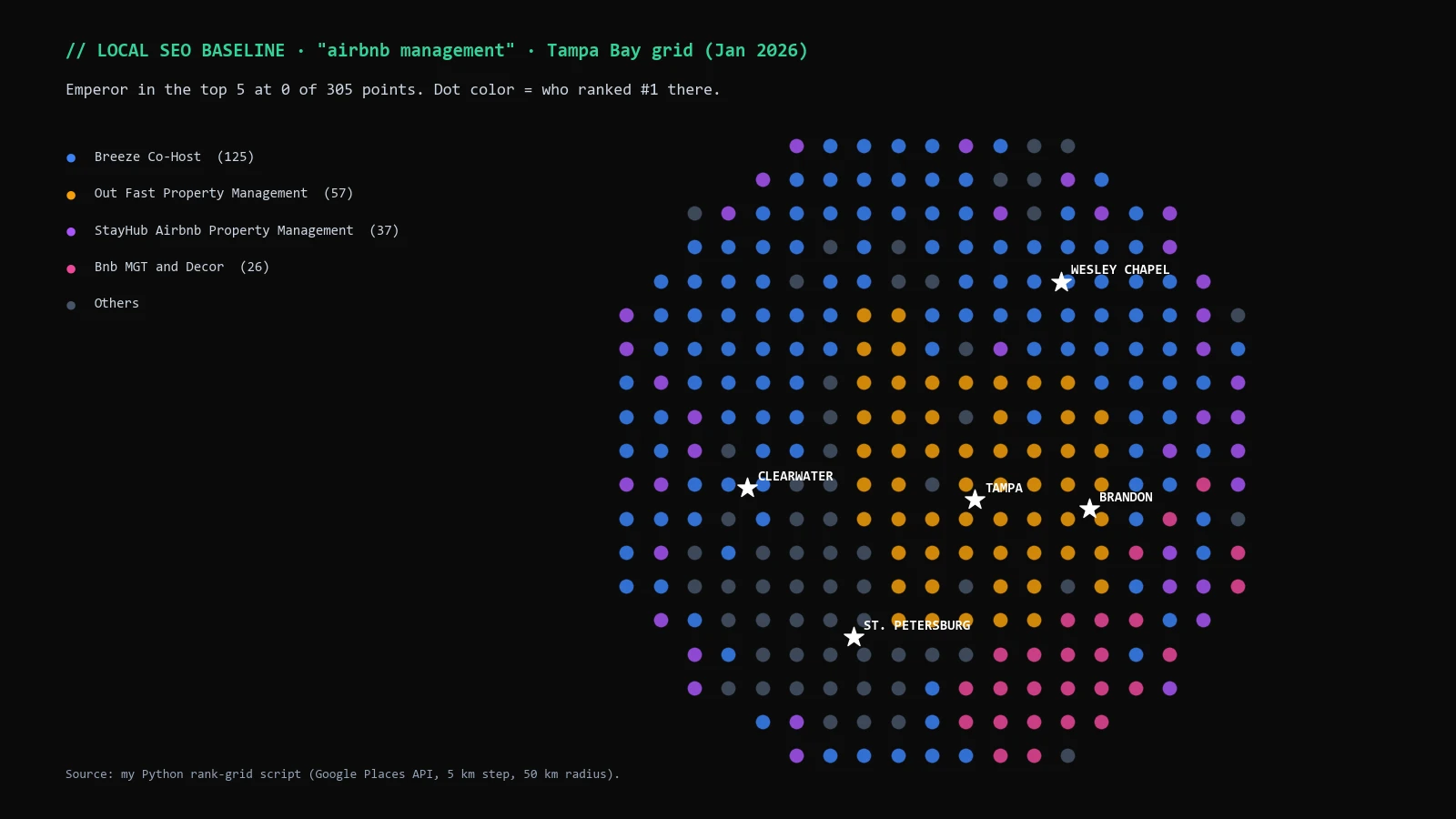
To measure that starting point I didn't rely on a paid tool. I wrote a Python script that builds a grid of coordinates around Tampa and, for each point, queries the Google Places API with "airbnb management" and saves the top 5.
The result was clear:
- 0 of 305 points with Emperor in the top 5;
- the market was split among four companies, with Breeze Co-Host ranking #1 at 125 points;
- at the point closest to Emperor's own office, #1 was a competitor, followed by two more.
That last finding is the most important one. Proximity is one of the strongest local ranking factors. When you don't rank even next to your own address, the problem isn't distance: it's relevance and trust, and those are what you can work on.
Where it stands now
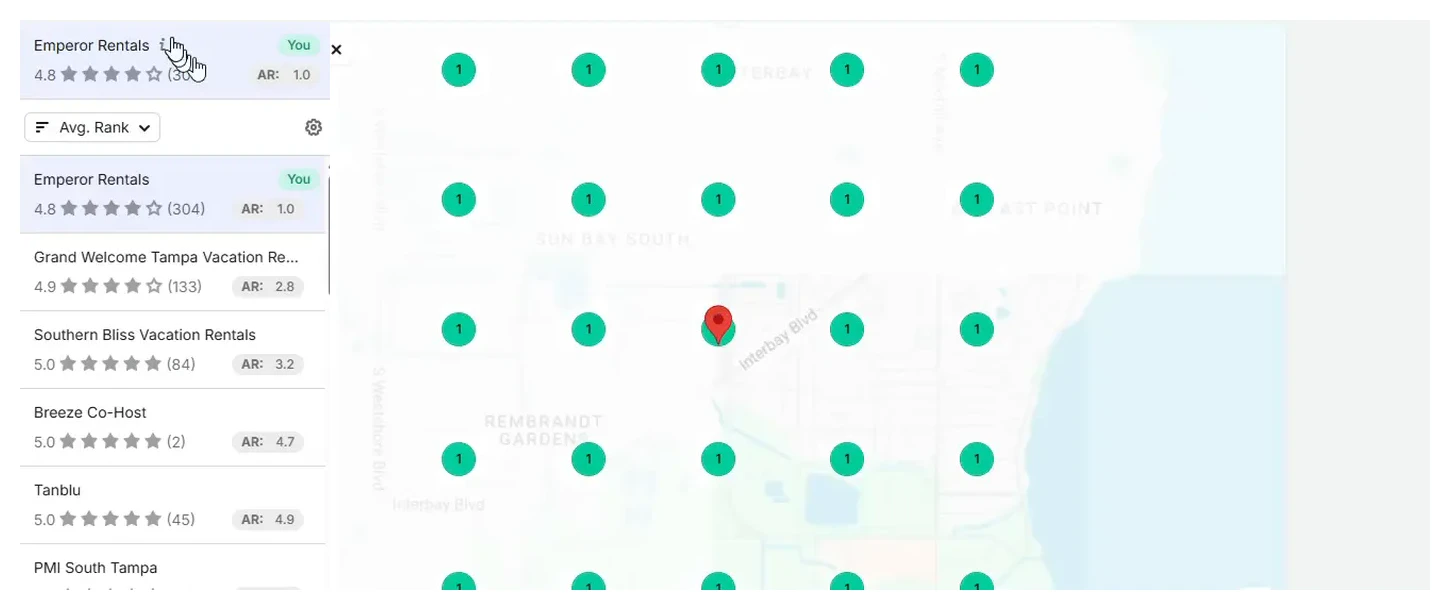
The current scan uses a commercial tool, Map Rank Tracker, on a 5x5 grid centered on the office in South Tampa. Every point is at #1. Emperor has a 4.8 rating from 304 reviews, and the next competitor averages position 2.8.
A note on honesty: the two measurements don't use the same method. The January one covered the whole bay with the Places API, and today's covers South Tampa with a dedicated tool. So I'm not claiming "#1 across all of Tampa Bay". The comparison that holds is the one that matters most for a local business: around its own address, the company went from outside the top 5 to first place.
What I did
No single trick. It was five fronts at the same time.
1. The Google Business Profile as the source of truth
The profile is the asset that feeds the Map Pack directly and, by extension, AI Mode. The work was keeping it complete and true: the right primary category, the services described in plain words, and the service areas matching the real operation (Pinellas and Hillsborough counties). For service-area businesses this matters twice: AI Mode uses that information to answer "who serves this area?".
Reviews are both a ranking factor and a conversion factor. At 304 reviews and 4.8 stars, the profile already convinces by itself.
2. A website that confirms what the profile says
I migrated emperormgmt.com from WordPress to Next.js and organized the site around service + city: Airbnb management in Tampa, in Clearwater, in St. Petersburg, plus dedicated location pages. Each page answers a real search and reinforces the same geographic relevance the profile declares.
To speed up discovery, I wrote a script that submits the site's URLs to Google's Indexing API in batches. In the last 3 months, emperormgmt.com reached 49.2K impressions in Search Console.
3. Consistent citations (NAP)
Citations are the business's mentions in directories: name, address, phone and website. Google and the AI assistants cross-check that data. If each directory says something different, the business loses trust.
So I wrote another Python script that visits 302 directory listings and checks each one. In my most recent audit: 54 listings fully correct, 53 missing data (usually the website), 13 dead links to rebuild, and 129 that blocked automated access and need a manual check. That turns "doing citations" into a to-do list with priorities.
4. Structured data and the files assistants read
Structured data (Schema.org) tells search engines, in a machine-readable way, what the business is, where it is and what it does. On top of that, I published llms.txt and set rules for AI crawlers in robots.txt.
To be precise: Google states that you don't need special files to appear in its AI features. llms.txt is a cheap bet aimed at assistants outside Google, not a ranking factor in Google. Don't let anyone sell you "GEO" as a replacement for the basics.
5. Measurement, from search to lead
Ranking doesn't pay the bills. Leads do. The measurement stack was:
- rank grid (my script and Map Rank Tracker) to see the map, not a single position;
- Search Console for impressions and queries;
- GA4, where AI assistants already show up as their own traffic channel;
- Microsoft Clarity to watch how visitors move through the site: dead clicks, rage clicks and quick backs show where the page loses people;
- GoHighLevel, where every lead from the form, Google or Meta arrives with its source, so I can tie the work to actual inquiries.
What this means for home services
Property management sounds far from roofing, HVAC or solar. The business model is the same: a service-area company that lives on calls and form fills from people within a few miles. The playbook transfers almost as is:
- a complete Google Business Profile with real service areas;
- one page per service and per city served;
- consistent citations, audited, not just created;
- reviews as an operational routine;
- measurement by grid and by lead, not by "position on keyword X".
For a contractor, the stakes are higher: an urgent job (a leaking roof, an AC that died in July) is decided in a few minutes, by whoever shows up first, in any of the three doors.
And the paid side?
Local SEO takes months. Ads buy time. For local services, the comparison that matters is cost per booked job, not cost per click:
- Local Services Ads charge per lead, and the badge sits above everything.
- Google Search Ads give you control over keywords, bids and landing pages.
- ChatGPT Ads are new and opened to US businesses, but there is still no pay-per-action bidding. Since October 30–31, "creative enhancements" are on by default, meaning ChatGPT can rewrite your headlines, descriptions and even the landing URL for each conversation. If you're testing it, check that setting in Ads Manager. I wrote my first impressions of the platform in this article.
The playbook I recommend is to test small, track every lead in the CRM and compare the cost per booked job of each channel over the same period before moving budget.
Bottom line
The map didn't change because of an AI trick. It changed because the business started telling the same story everywhere: on the profile, on the site, in the directories and in the reviews. That's exactly the material Maps, AI Mode and ChatGPT use to decide who to recommend.
Three doors, one customer, and one job well done that works for all three.
Sources
- Google Search Central — AI features and your website
- CXL — Google's AI search optimization guide is right about the basics
- Human Level — Google AI Mode and local search results
- Whitespark — Guide to Google's AI Mode for local businesses
- MEAN CEO — Local SEO News, October 2026
- Search Engine Land — ChatGPT Ads to enable creative enhancements on October 30
- OpenAI Help — Creative enhancements for ChatGPT Ads
- LocalFresh — ChatGPT Ads for local businesses

Written by
Paulo Victor Fraga
Comments(0)
Be the first to comment.