
In 1770, a robot plays chess at the Habsburg court in Austria and beats almost everyone in games lasting under half an hour. Over more than eighty years, the same machine tours Europe and the United States and, according to some accounts, even defeats Napoleon Bonaparte and Benjamin Franklin. This "mechanical marvel," as people called it at the time, became known as the Mechanical Turk, and it was so impressive that it led many to wonder whether a machine could really think. It's a question we're still asking today.
This text is about artificial intelligence and about an invisible detail that makes it work. But it also has a personal side. I play chess as a hobby, thanks to my father's influence, and every now and then I still sit down for a game. I'm no master, far from it. But anyone who plays, even as an amateur, sooner or later runs into the history of chess-playing machines. And few stories explain what is happening with AI today as well as this one. First, though, we need to understand the Turk.
The show
If you could travel back to the late 18th century and watch the Turk perform at some court or salon, you would see a wooden cabinet a little over 1 meter wide, on small wheels, with a chessboard on top. Seated behind it was a life-size figure dressed as a Turk: turban, robe and a pipe in hand.
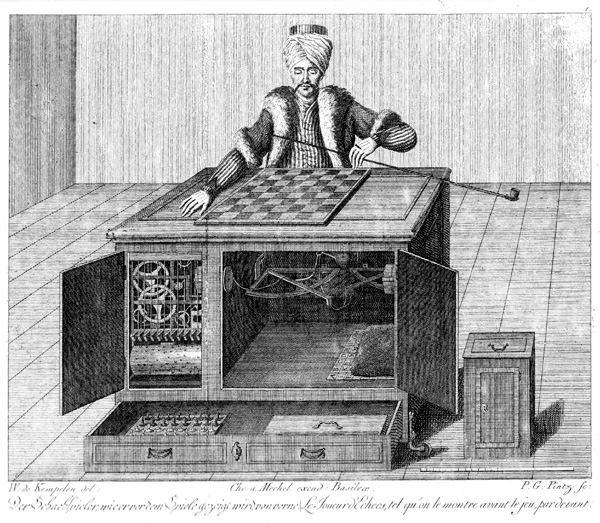
Before the game, which was the heart of the show, the presenter opened the cabinet doors one at a time. Inside you could see a tangle of gears and a cylinder full of pins, like the mechanism of a music box. Behind one of the doors he would even place a lit candle so the audience could see the light pass through the interior from one side to the other. Then he would step back and let anyone approach with a magnet, to prove there was no magnetic trick. The idea was to convince everyone that the Turk was just a machine.
That done, the presenter closed the cabinet, wound a crank, said to be very noisy, and the figure began to play against a challenger. And it played well. It moved the pieces with its left hand, nodded its head when giving check, and put a piece back if the opponent tried an illegal move. It almost always won. An 1820 book records fifty of its games: 45 wins, three losses and two draws. At that point it was still playing a pawn down and always letting the opponent move first.
Anyone who plays chess knows the weight of those numbers. Giving up a pawn and the first move is no small thing: against a halfway serious opponent, it's a considerable handicap. Winning 45 out of 50 games under those conditions is not amateur stuff like mine. That's master level.
The success was total. Nobody understood how it was possible, and stories began to circulate about famous games against famous people. It's said the Turk beat Napoleon, but the records can neither confirm nor deny it. The alleged game against Benjamin Franklin, in Paris, also reached us only through second-hand accounts, and the passage of time makes any certainty impossible.
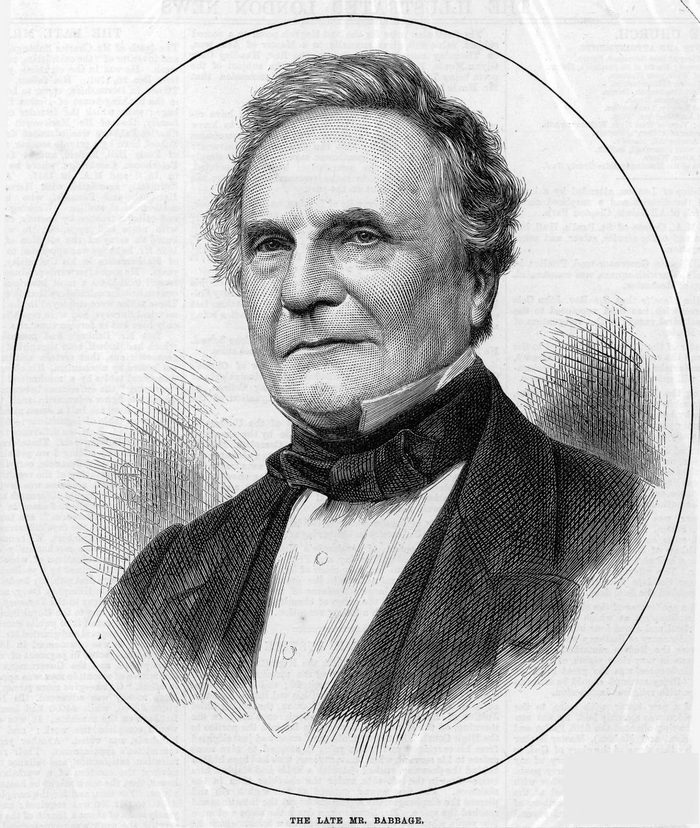
One game, however, certainly happened: in 1819, the Turk faced the English mathematician Charles Babbage, considered one of the inventors of the computer. Babbage lost, but came away convinced that a machine could, indeed, play chess, and years later even sketched a design for one. However much these shows smelled of trickery, they fired the imagination of people like Babbage, who would later build machines capable of imitating not only human physical labor but mental labor.
Much later, in 1997, IBM's Deep Blue defeated world champion Garry Kasparov. Today, no human beats a chess computer running at full strength. But at the turn of the 19th century we were still very far from a Deep Blue. So how was the Turk already beating chess masters?
Automata and the border between human and machine
Some already suspected the Turk was a human disguised as a machine. Either way, it blurred the line between natural and artificial, organic and mechanical, human and machine. And that blurring didn't come from the Turk alone. It was part of a broader context: the construction of ever more sophisticated automata.
Between the Enlightenment and mechanism, clocks began to feature figures that appeared when the hours struck, like cuckoo clocks, only with dozens of figures interacting and performing entire sequences of movements. It was the "age of the clockmaker," when even philosophy started using mechanical models to explain nature.
And it wasn't just clocks. There was a mechanical flute player that played a real flute. There was a duck that ate and "digested" its food, though the digestion was a trick: the droppings were already prepared inside it, but the whole live performance of defecating was very sophisticated. There was a musician whose chest rose and fell as if she were breathing, and a doll that wrote letters.

Alongside these inventions, shown in grand spectacles, ran a serious philosophical debate about what, after all, separated humans from machines, since machines imitated people better and better.
Descartes' tests
René Descartes, the "I think, therefore I am" philosopher, proposed a century before the Turk a thought experiment that is very useful here. Suppose someone built a machine that looked exactly like a human being. How would you know whether it was a person or a machine?
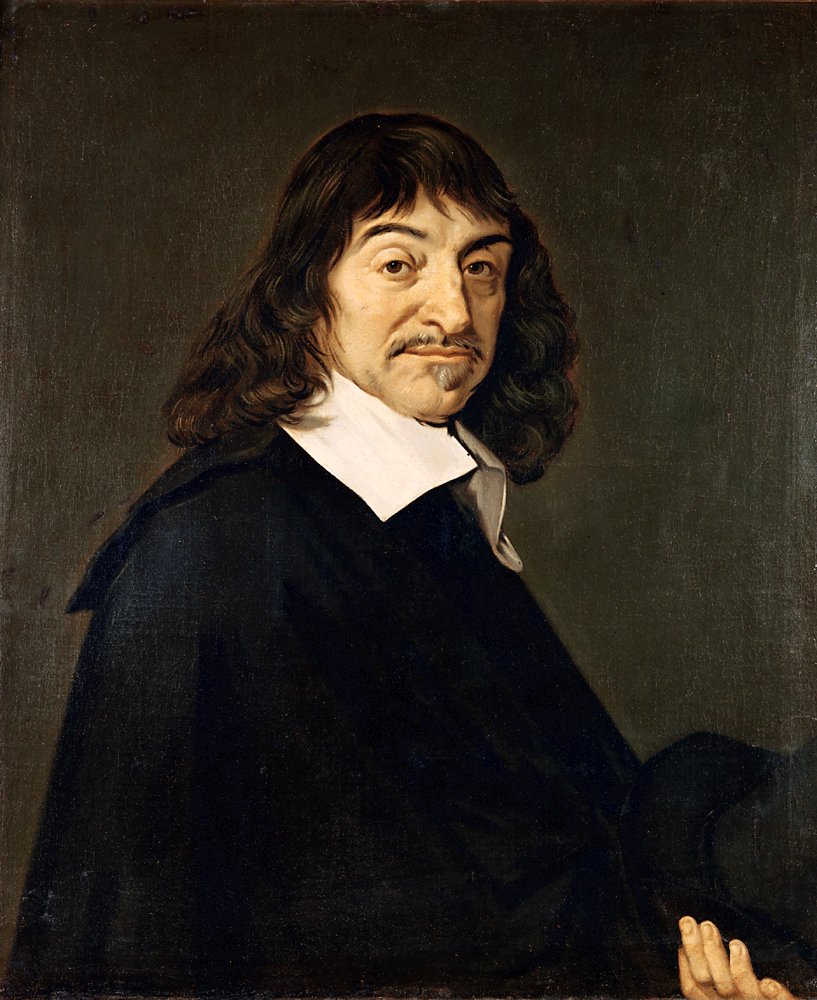
For Descartes, there were two main ways to find out. The first was conversation. A machine might speak and answer certain questions, but it could not arrange its words in different ways to respond to the meaning of everything said in its presence. In other words, it could produce canned phrases, each triggered by a specific stimulus, like pressing a button, but it couldn't keep up with any question. It would lack the capacity to improvise.
That test, of course, no longer works. Holding a conversation with apparent naturalness is the bare minimum for any chatbot today. With an AI, you can talk indefinitely, get work tasks done and, with a bit more skill, build app prototypes or systems with multiple agents carrying out tasks on their own.
The second test was to watch the machine in different situations. It might do some things as well as or better than a human, but it would fail at others, because it wouldn't have the same versatility. That specialization would show that it acted not from knowledge but from the "disposition of its organs," that is, from the way its parts had been assembled to act. Reason, for Descartes, was a universal instrument, applicable to any situation. A mechanism, by contrast, needs a specific arrangement for each action, and no machine could hold enough parts to handle all the diversity of life. The test, then, was to take the machine out of what it was built for and see if it adapted.
The Turk, though it did only one thing, seemed to have enormous adaptability, because chess offers an almost infinite universe of situations, each demanding a specific answer. There is no predictable sequence from start to finish: every game is different, and every move by the opponent opens a new branch of possibilities. Anyone who has played a few games knows this: all it takes is for your opponent to stray a little from the expected opening and everything you planned goes out the window. By Descartes' reasoning, playing chess would be a single task, but too open and complex for a machine. And yet the Turk played.
The secret
The secret is that the Turk didn't play chess. As some already suspected, it was a natural intelligence disguised as an artificial one. We know this because, a few years after the machine was destroyed in a fire at a museum in Philadelphia, the son of its last owner published in a chess magazine the full explanation of how it worked: there had been a real chess player hidden inside the whole time.
And how did nobody see him, if the presenter opened the doors in front of everyone? Pure stage magic. Since the doors were opened one at a time, the player moved on a seat that slid along rails, hiding as each door opened.
And how did he see the board, which was outside, and move the pieces? This is the most ingenious part. Each piece had a magnet in its base, and under each square of the board, on the inside of the cabinet, there was a small metal disc attached to a spring. When a piece landed on a square, the magnet pulled the disc up; when it left, the disc dropped. By watching these discs, the player knew where each piece had come from and where it had gone. He reproduced the moves on a small private board, worked out his reply and moved the figure's arm with an articulated lever, a pantograph that copied the movement of his hand. That way he could point to the square, lower the figure's hand and open or close it to drop or pick up a piece. All of this by candlelight, in a cramped, hot, smoky space, with the smoke even escaping through the figure's turban.
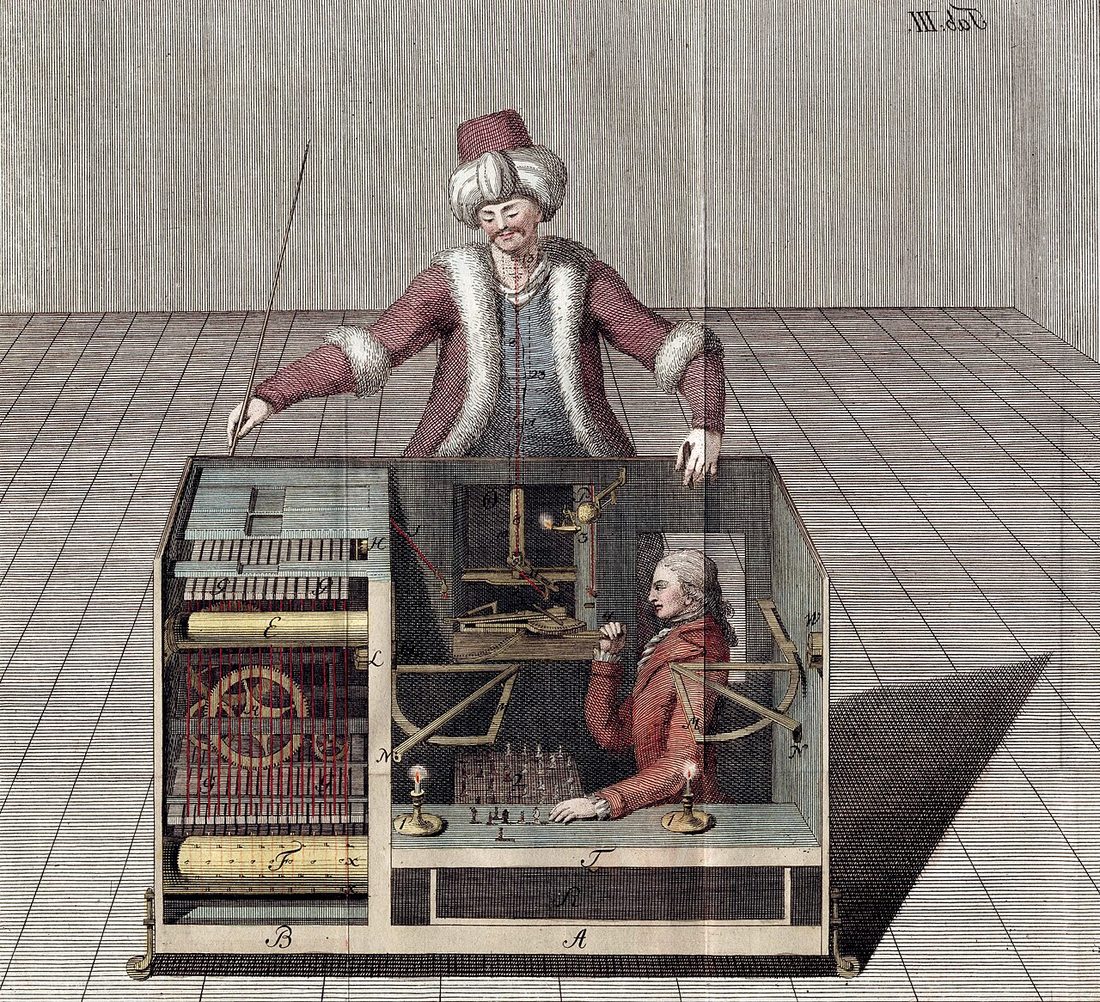
I confess this part impresses me more than any gear. I already find it hard to play well sitting in a comfortable chair, looking straight at the board. Imagine playing in the dark, squeezed in, rebuilding the position from metal discs, and still winning.
So there was a magnet trick, but it was on the inside. When someone approached with a magnet at the start of the show to check, they found nothing, because the mechanism was hidden. The test was worthless.
What looked like an intelligent machine was in fact an intelligent person hidden behind a mechanism with no intelligence at all. A hidden worker behind an appearance of automation.
Contemporary mechanical Turks
In a way, this still exists today. The most direct example is a service Amazon launched in 2005 called, fittingly, Amazon Mechanical Turk. When a company's software hit a task the machine couldn't solve on its own, such as describing what's in a photo, transcribing a few seconds of audio or checking whether two listings were for the same product, it sent the task to the platform, which distributed it to people around the world, paid a few cents per microtask. The answer came back to the program as if it were the machine's own computation, but it wasn't. Amazon itself called it "artificial artificial intelligence." The service was recently shut down.
Another example is some humanoid robots that are more human than they look. At a Tesla event in 2024, robots moved among the guests, chatted and served drinks, like an episode of The Jetsons or a film like I, Robot. But according to news reports at the time, much of that interaction was remotely controlled by company employees: they were teleoperated robots.
In 2025, the robotics company 1X launched Neo, a home humanoid robot that would tidy your house for you. Except that many tasks it couldn't do on its own, and it had to be operated remotely by an employee wearing a virtual reality headset, who saw your home through the robot's cameras. This wasn't exactly hidden; it was on the website for anyone who looked. But in the press coverage the teleoperation went almost unnoticed, and it really did look like the Jetsons' robot maid. Once again, there was hidden human work behind the appearance of automation.
Human work as the structure of AI
This hidden human work, disguised as or blended with the machine's work, is very common in Brazil. A recent survey counted 54 microtask platforms operating in the country, 29 of them with data tasks for artificial intelligence. People who work on them spend the day doing small pieces of the machines' work: labeling photos, transcribing audio, checking answers generated by systems.
One case cited in the study is that of a 54-year-old worker who spent two days moving her own dog's poop around and taking more than 250 photos to teach robot vacuums to avoid pet waste. She prepares the machine to act on its own; once the robot is trained, she won't be hidden inside it. It's not exactly a mechanical Turk, but a kind of neo-mechanical-Turkification: making artificial intelligence possible through continuous inputs of natural intelligence.
This is different from building an ordinary mechanism, like a clock, which a human assembles and which then runs by itself. With today's AI, human work, often hidden, is structural and continuously necessary for it to operate.
A group of French researchers who studied this market divided this human-machine symbiosis into three levels. The first is preparing the machine, producing the examples it learns from: labeling photos, drawing boxes around objects, recording phrases, filming yourself with a phone strapped to your forehead doing a task so the machine can learn to replicate it. Here, the human works first, and then the machine acts alone.
The second is checking and correcting what a system already in operation produces, such as reviewing a voice assistant's transcriptions or content moderation decisions. Here, the human works alongside the machine, continuously.
The third, rarer, is working in place of the machine: the classic mechanical Turk situation. That's the case of teleoperated robots, or of a French startup selling "smart" anti-shoplifting cameras that actually used workers in Madagascar to watch part of the footage live.
So there is the human who teaches the machine, the one who corrects it and the one who sometimes plays its role. In every case, what we call artificial intelligence wouldn't work the way it does without these hidden workers. Hence neuroscientist Miguel Nicolelis's claim that artificial intelligence is neither intelligent nor artificial. The statement is debatable. The first half depends on a definition of intelligence, which varies a lot. But the second half, that AI isn't artificial, is exactly the point here. According to Nicolelis, there is an army of people behind it making it work. Behind the appearance of pure machine intelligence there is a great deal of human work, sometimes explicit and recognized, sometimes hidden and undervalued, but always structural.
Where the analogy ends
Unlike the Turk, however, AI is not only that hidden army. This is what separates today's situation from the 18th century's. Take away the hidden chess player and the Turk does nothing at all. Today's AI, however fundamentally it depends on people to be trained and corrected, has a degree of autonomy that can't be dismissed.
The programs that beat chess champions today need no human input to keep winning. They are genuine mechanisms, with an intelligence, if we want to call it that, that is also genuine. There's no trick and no mere show: the ability to beat any human player lies in the mechanism itself.
And here I also speak as someone who plays. The road to this point went through three moments that every chess player, even a weekend one, knows in some way, and that are worth telling carefully.
Kasparov versus Deep Blue
For anyone who plays chess, even as a hobby, Garry Kasparov is something of a legend. And he was the one at the center of the moment when the machine pulled ahead.
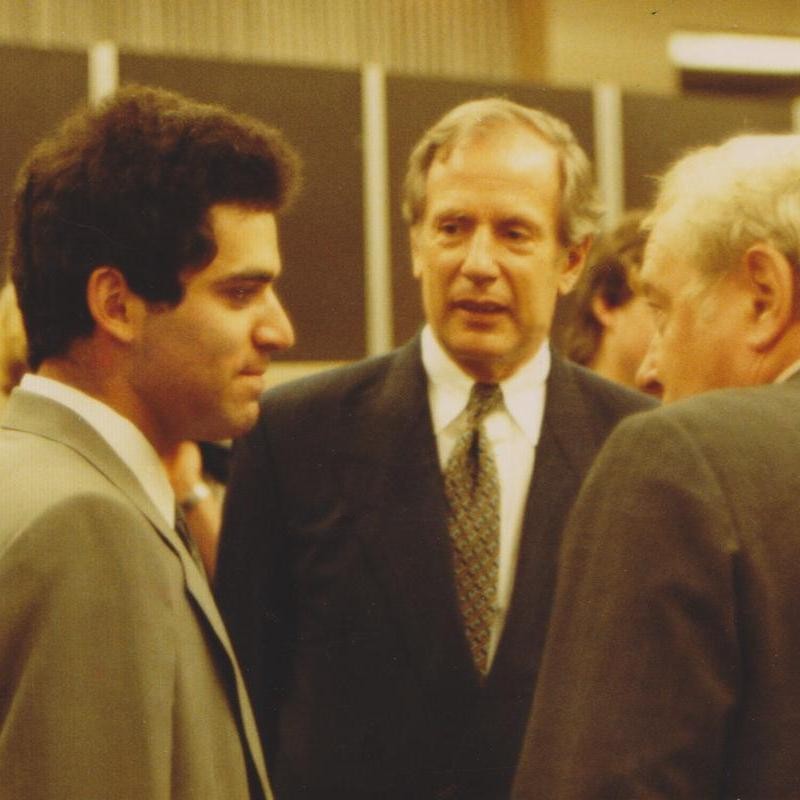
In 1985, Kasparov, then 22 and a few months away from becoming the youngest world champion in history, played 32 chess computers at once in a simultaneous exhibition in Hamburg, Germany. He won all 32. A little over a decade later, things would be different.
Deep Blue grew out of a student project at Carnegie Mellon University in the United States. In the 1980s, Feng-hsiung Hsu began developing chips dedicated solely to calculating chess moves. The project went through machines called ChipTest and Deep Thought before moving to IBM, where, with Murray Campbell and other engineers, it became Deep Blue. Instead of imitating the human way of thinking, it bet on brute force: the 1997 version was a supercomputer with 480 custom-built chess chips, able to evaluate about 200 million positions per second. In a relaxed game, I evaluate maybe half a dozen moves, if I'm lucky, before touching a piece.

The first match was in February 1996, in Philadelphia, the same city where the Turk had burned to ashes more than a century earlier. Deep Blue won the first game, the first time a reigning world champion lost to a computer in a game at tournament time controls. But Kasparov recovered and won the match 4 to 2.
The rematch, in May 1997 in New York, ended differently. Kasparov won the first game. In the second, Deep Blue played in a way that rattled him: instead of grabbing pawns and winning material right away, as a machine was expected to, it played patient positional moves that looked very human. Kasparov resigned in a position that, it later turned out, could still have been drawn by perpetual check. Anyone who plays knows the pain of resigning and then finding out there was a way out; watching it happen to the best player in the world, in a historic match, is almost comforting. The next three games were drawn. In the sixth and deciding game, on May 11, Kasparov made a known opening mistake, Deep Blue sacrificed a knight and the champion resigned after just 19 moves. Final score: 3.5 to 2.5. For the first time, a world champion lost an entire match to a computer under tournament conditions.
The most interesting part for this text, though, is what came next. Kasparov accused IBM of cheating. He suspected that in the second game some human grandmaster had intervened in the machine's decisions, because those moves looked too human. He demanded to see the computer's logs. IBM refused at the time, turned down a rematch and dismantled Deep Blue shortly afterward. The logs were only published later.
It's the Mechanical Turk in reverse. In the 18th century, the public saw a machine and, suspicious, asked whether there was a human hidden inside. And there was. In 1997, the greatest chess player in the world asked exactly the same question. This time, there wasn't. No proof of human intervention during the games ever surfaced, and Kasparov himself, twenty years later, in the book Deep Thinking (2017), backed away from direct accusations of cheating and apologized for some of his conduct in that match.
But the answer isn't that simple. There were humans behind Deep Blue, just not hidden inside the box. IBM's team included grandmaster Joel Benjamin, who helped prepare the opening repertoire, and the rules allowed the engineers to adjust the program between games. Deep Blue's strength was, to a large extent, human chess knowledge translated into code: the opening tables, the criteria for evaluating a position, the weight given to each piece and each pawn structure, all of it written by people. The machine calculated on its own, but it calculated with a human ruler. In the French researchers' classification, it's the first and second levels at once: humans preparing the machine beforehand and adjusting it between games.
Stockfish: an engine built by thousands of hands
After Deep Blue, the strength of chess programs no longer depended on supercomputers. With ordinary processors getting ever faster and algorithms ever more efficient, engines running on a personal computer soon played better than any human. The strongest of them, and perhaps the most famous, is Stockfish.
If you play chess today, even occasionally, you've probably crossed paths with it, even without knowing its name. It powers game analysis on a large share of chess websites and apps: it's that little bar that tilts to one side or the other and, with relentless coldness, points out where you went wrong.
Stockfish was born in 2008, when Italian programmer Marco Costalba created a modified version of Glaurung, an open-source engine written by Norwegian Tord Romstad. Soon after, Finnish developer Joona Kiiski joined the project. The name is a joke: the program was "produced in Norway and cooked in Italy," like stockfish, the Norwegian dried cod that Italians eat so much of.
What sets Stockfish apart is that it's free software: anyone can read, copy and improve the code. And a lot of people did. In 2013, Gary Linscott created Fishtest, a distributed testing platform. Every improvement a programmer proposes is tested over thousands of fast games, played on volunteers' computers around the world, who donate their machines' idle time. Only what demonstrably makes the engine stronger gets into the code. To date, it has played more than 10 billion games.
For more than a decade, Stockfish worked as a far more refined version of Deep Blue's logic: an extremely efficient search for the best moves, combined with a hand-written evaluation function in which programmers defined what makes a position good or bad, how much a bishop is worth, a passed pawn, an exposed king. It was human chess knowledge, distilled and calibrated by statistical testing. Deep down, the same lessons anyone learns when they start playing, only written in code and tuned with a precision no teacher could match.
That changed in 2020. Stockfish 12 added a small neural network called NNUE, a technique originally created by Japanese programmer Yu Nasu for shogi, Japanese chess. Instead of following rules written by people, the evaluation of positions came to be learned from millions of examples. The jump in strength was immediate and, in 2023, the hand-written evaluation was removed for good. Today the gap between Stockfish and the best player in the world is so large that a game between the two would be no fun at all.
And much of that shift was triggered by a shock the chess world got in 2017.
AlphaZero and Leela Chess Zero: learning without a human teacher
In December 2017, DeepMind, Google's artificial intelligence lab, unveiled AlphaZero. Unlike every engine before it, it received no chess knowledge beyond the rules: no openings, no grandmaster games, no criteria for the value of the pieces. It learned by playing against itself millions of times, with a neural network guiding its search for moves. After four hours of training, on Google's gigantic hardware, it already surpassed Stockfish. In a hundred-game match, it won 28, drew 72 and lost none. The conditions of the match were criticized, because Stockfish played without its opening book and with a fixed time per move, but AlphaZero's style was striking: it sacrificed material for long-term advantages, in a game many described as more creative and even more "human" than that of traditional engines.
That detail catches my attention. Everyone who learns chess first learns the table of values: a pawn is worth one, knight and bishop three, rook five, queen nine. It's one of the first things you teach a beginner. AlphaZero never received that table, and still arrived at a game where the pieces were worth what the position said, not what the table said.
DeepMind, however, never released AlphaZero to the public. That's where the community came in. In January 2018, the same Gary Linscott of Fishtest started Leela Chess Zero, or Lc0, based on Leela Zero, a project in which programmer Gian-Carlo Pascutto had recreated DeepMind's method for Go as open source. The idea was to reproduce AlphaZero openly, so anyone could use and study it.
Leela started from absolute zero. Its first versions played practically random moves, worse than a beginner's. But, like Stockfish, it relied on volunteers: thousands of people lent their graphics cards to generate games of Leela against itself, more than 2.5 billion over the years, which served as training material for the neural network. In a little over a year, it went from beginner to the top: in 2019, it won the TCEC superfinal, the most important computer chess championship in the world, defeating Stockfish itself, and repeated the feat in 2020.
The rivalry ended up being good for both. Starting in 2021, Stockfish's neural network was also trained on positions generated by Leela, and Stockfish took back the top spot: since then it has won every TCEC superfinal, almost always against Leela.
In this story, the nature of human work changes. In the Turk, the human did everything: he was the one playing. In Deep Blue, humans wrote the chess knowledge the machine used to calculate. In modern Stockfish and in Leela, nobody teaches the machine chess. Leela never saw a human game. Even so, there are people everywhere: those who write the code, those who design the tests, those who lend their computer overnight. But this work is visible, credited and often voluntary, very different from the chess player suffocating inside the cabinet or the worker photographing dog poop for pennies. And when the game starts, there's nobody behind the curtain. Take all those people out of the room and Stockfish keeps winning. That's exactly what the Turk could never do.
And, funnily enough, none of this has taken away my desire to play. Knowing there's an unbeatable machine doesn't change the pleasure of sitting in front of a board, thinking up a plan, making a mistake and learning from it. The chess my father introduced me to is still a game between people. The machine has become something else: a study tool, a patient teacher, sometimes a slightly cruel judge. But the game, the one we play for fun, is still ours.
Beyond the board
There are even more striking examples. The 2024 Nobel Prize in Chemistry went in part to the creators of AlphaFold, an artificial intelligence model that solved a fifty-year-old problem: predicting the structure of proteins. It has already predicted the shape of practically all 200 million known proteins and is used by more than 2 million people in 190 countries to study everything from antibiotic resistance to enzymes that can break down plastic. No imaginable number of people labeling photos could do what this machine did. The same goes for solving mathematical problems.
Whether this is intelligence or not depends on your definition, which is quite open. But it's certainly something new, with enormous potential both for good, as in chemistry and medicine, and for harm, which is where the spotlight usually is. That concern is fair and makes sense, but there's also a whole positive side: the potential for every area of human knowledge to develop through artificial intelligence.
References
The Mechanical Turk
- Wikipedia — The Turk
- IEEE Spectrum — when Charles Babbage played the Turk
- Discover — the Turk and the first computers
Contemporary mechanical Turks
- TechRepublic — Amazon Mechanical Turk shut down on September 30, 2026
- The Decoder — the end of "artificial artificial intelligence"
- TechSpot — human-controlled Optimus robots at Tesla's event
- Road to VR — 1X's Neo and its remote VR operators
Human work in AI
- DiPLab & LATRAPS — Microwork in Brazil (2023, in Portuguese)
- Outras Palavras — the Brazilians who feed AI (in Portuguese)
- Terra — microworkers train AI even with photos of poop (in Portuguese)
- Tubaro, Casilli and Coville — The trainer, the verifier, the imitator (2020)
- Band — Nicolelis: AI is neither intelligent nor artificial (in Portuguese)
Kasparov and Deep Blue
- Chessprogramming — Kasparov vs. 32 computers in Hamburg, 1985
- Wikipedia — Deep Blue)
- Wikipedia — Deep Blue versus Garry Kasparov
- MIT Technology Review — Kasparov revisits the defeat in Deep Thinking
Stockfish, AlphaZero and Leela Chess Zero
- Wikipedia — Stockfish)
- Chessprogramming — Stockfish NNUE
- Stockfish — the Stockfish 14 release and Leela's data
- Chess.com — AlphaZero beats Stockfish in a 100-game match
- The Register — criticism of the match conditions
- Wikipedia — Leela Chess Zero
AlphaFold

Written by
Paulo Victor Fraga
Comments(0)
Be the first to comment.